

Table of Contents
1.0 Executive Summary
On April 27, 2026, the U.S. Food and Drug Administration announced a fundamental change in clinical trial data handling. For the first time in over six decades, the agency will shift from batch-based, years-delayed submissions to continuous, AI-powered, cloud-enabled real-time monitoring.
The impact is profound. Once criticized for bureaucracy, the FDA increased its AI workforce engagement from 1% to over 80% in twelve months, merged 40 IT systems into one, and launched the first real-time clinical trial program with two major pharmaceutical companies. The message to the life sciences community, especially pharmaceutical manufacturers, is clear: if the regulator can transform its operating model, the industry must follow.
2.0 The Article in Focus: What the FDA Announced
The Real-Time Clinical Trial Pilot
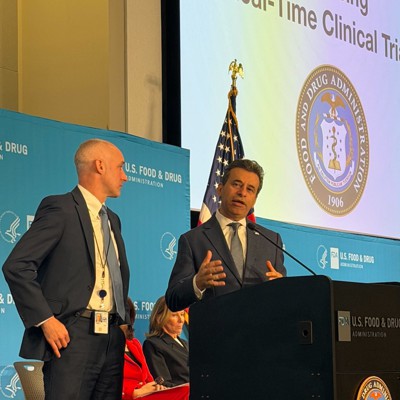
FDA Commissioner Marty Makary unveiled what he called "the first ever real-time clinical trial" at a press conference at the agency's Silver Spring, Maryland headquarters on April 27, 2026. The program lets the FDA receive a direct, cloud-based data feed from active clinical trials. When a patient in a trial develops a fever or a tumor shrinks, FDA regulators can observe that event in near real-time instead of waiting months for data to pass from clinical site to sponsor to agency.
Two proof-of-concept studies are already underway:
AstraZeneca's TRAVERSE Trial — A Phase II multi-site study in treatment-naïve mantle cell lymphoma, conducted at institutions including MD Anderson Cancer Center and the University of Pennsylvania. The FDA has already received and validated signals from this trial through Paradigm Health's Study Conduct Platform, confirming technical feasibility.Amgen's STREAM-SCLC Trial — A Phase 1b study of tarlatamab in patients with limited-stage small cell lung carcinoma, with final site selections underway.For both trials, the FDA collaborated with sponsors to define criteria for sharing safety and efficacy signals in real time. This approach does not collect every patient-level data point; instead, it uses macro-level, signal-based monitoring to provide regulators a real-time view of trial performance without disrupting clinical protocols.
3.0 The Technology Stack: Cloud + AI + Paradigm Health
The platform supporting the pilot Paradigm Health's Study Conduct Platform and SPIRE clinical trial ecosystem automates data collection and analysis, enabling near real-time reporting within days instead of months. All clinical trials in the broader RTCT program will use this platform through a formal collaboration with the FDA.
The FDA issued a Request for Information (RFI) seeking public and industry input on how AI-enabled technologies can improve "efficiency, speed and quality of decision-making in early phase clinical trials." Responses are due May 29, 2026, with a broader pilot launch planned for summer 2026, final selection criteria in July, and pilot selections completed by August 2026.
4.0 Contextualizing the Scale of FDA's Internal Transformation
From 1% to 80%+ AI Adoption within One Year
A striking statistic from Commissioner Makary's April 2026 press conference, unrelated to clinical trials, is that FDA Chief AI Officer Jeremy Walsh revealed that in early 2025, about 1% of the FDA's workforce regularly used generative AI in their daily work. By Walsh's speech at Google Cloud Next in Las Vegas in late April 2026, that figure exceeded 80% agency-wide, with some centers surpassing 90%.
This is not incremental change but institutional transformation at a pace most private organizations struggle to match. Despite significant staff cuts in early 2025, losing thousands of employees, the agency advanced without requesting extra resources.
The catalyst was a purpose-built tool. Elsa, the FDA's large language model-powered generative AI assistant, launched in February 2025 ahead of schedule and under budget, serves as the backbone of daily AI use across the agency. Elsa runs on FedRAMP-compliant GovCloud infrastructure, powered by Anthropic's Claude and Google's Gemini models, and assists employees from scientific reviewers to field investigators in reading, writing, summarizing reports, reviewing clinical protocols, analyzing adverse events, comparing product labels, and generating code. Crucially, it does not use confidential industry data for training, preserving regulatory privacy standards.
What Elsa and its supporting AI infrastructure have delivered is staggering in practical terms: administrative tasks that previously consumed 10 days of expert time have been compressed to 20 minutes.
5.0 IT Consolidation: Dismantling the Fiefdom Model
Beyond AI adoption, the FDA has carried out one of its most aggressive IT rationalization programs. Under Commissioner Makary's leadership and without extra budget, the agency:
Consolidated 40 separate application intake systems into a single unified system
Reduced three separate data monitoring systems to one platform
Collapsed seven adverse event reporting systems into one
Eliminated widespread software license duplication across the agency's centers
The projected savings: at least $120 million annually, which Commissioner Makary pledged to reinvest in scientific staff, new technologies, and rehiring up to 3,000 scientists. This is not a cost-cutting exercise disguised as innovation; it is a fundamental reset of how a major regulatory institution organizes its digital infrastructure.
The vision behind this consolidation is what Makary called a break from "the fiefdom culture where every center has its own license agreement for the same software and its own system." For life sciences manufacturing leaders who have operated under this siloed model for decades, this language should sound familiar.
6.0 Why This Changes Everything for the Life Sciences Industry
Breaking the 60-Year Paradigm
For over six decades since the Kefauver-Harris Amendment of 1962, the clinical trial process has kept the same information architecture. Data flows linearly, causing months-long delays between clinical site events and regulator knowledge. Commissioner Makary stated: "For 60 years, we've been conducting clinical trials in the same way, where key data signals can take years to reach the FDA."
About 45% of the time between a Phase 1 clinical trial and final regulatory submission is "dead time" spent on paperwork, administrative tasks, and waiting for data to pass through bureaucracy. AI and real-time cloud connectivity target this dead time. FDA Chief AI Officer Jeremy Walsh estimates the pilot could reduce overall clinical trial time by 20%, 30%, or even 40%, which on a 10-to-12-year drug development cycle means potentially 2–5 years of compressed timelines.
To grasp the scale: the average timeline from discovery to approval is 10–15 years, with clinical phases alone taking about 7.9 years. Even a 30% cut in clinical and review phases marks a transformative shift for regulators and patients awaiting life-saving therapies.
Competitive Geography: A U.S. Advantage in the Making
The initiative carries a geopolitical dimension that pharma leadership cannot afford to ignore. As the FDA explicitly noted, many companies have shifted clinical trials to China, Australia, and other regions with faster, lower-cost operating environments. The RTCT program is designed in part to make the United States a more competitive location for pharmaceutical research. If real-time regulatory monitoring becomes the standard for U.S.-based trials, sponsors running complex multi-site oncology studies may find compelling operational and risk-management reasons to re-anchor their trial infrastructure in the U.S..
Smaller Biotechs and Adaptive Trial Design
The benefits of this paradigm are not limited to large-cap pharma. For smaller biotech companies, the ability to receive near real-time go/no-go signals from early phase trials represents a potentially company-saving capability. Biotech companies frequently burn through capital waiting months for safety and efficacy readouts; real-time monitoring could dramatically shorten the window between data generation and investment decision-making. This democratization of data velocity could reshape biotech capital allocation in material ways.
7.0 The Message to Pharma Manufacturing: Time to Stop Spectating
The Inaction Epidemic
The FDA's transformation puts a painful spotlight on a well-documented but rarely confronted reality: the pharmaceutical manufacturing sector has been chronically slow in its own digital and AI transformation. Industry data is unambiguous:
49% of pharmaceutical professionals cite a shortage of specific skills and talent as the top barrier to digital transformation (GlobalData, 2024)
44% of life science R&D organizations report lack of AI/ML skills as a major obstacle (Pistoia Alliance)
43% of pharma stakeholders say technology demand is growing faster than the supply of specialists who can support it
95% of pharma AI pilots never successfully progress to production deployment
Organizational silos are cited by 36% of respondents as a major barrier to digitalization
The vocabulary that characterizes pharma's digital posture is revealing. Industry observers describe manufacturers as "afraid to move," operating under the principle that "if the channel is unfamiliar, it's better to wait" and "if there's uncertainty, you'd better say no." This culture of digital risk aversion has a concrete cost: being a digital laggard can cost pharmaceutical companies two to three times more in the long run.
Meanwhile, the FDA, a government agency facing budget constraints, workforce reductions, and public accountability pressures, achieved in one year what most pharma companies have not in a decade of digital transformation.
The AI Adoption Gap: FDA vs. Pharma Industry
The contrast between FDA's AI adoption trajectory and the pharmaceutical industry's is stark.

The most alarming aspect of this comparison is not that the FDA leads in AI tools but that it succeeded where pharma repeatedly failed to close the gap between awareness and action. Nearly all pharma firms report some AI activity, yet only a fraction have mature deployment programs. The FDA committed to and achieved agency-wide rollout on an aggressive schedule, under budget and ahead of deadline.
Manufacturing's Specific Reckoning
For pharmaceutical manufacturing specifically, the RTCT pilot carries a direct operational implication, the regulator now expects data-driven, real-time visibility into clinical evidence. This expectation will extend from clinical trials to the manufacturing floor. The FDA's AI strategy including the CDEROne Intelligent Data Lake, AI-driven inspection targeting, and unified adverse event reporting, signals a regulatory future where manufacturers who quickly surface, contextualize, and transmit quality and safety data to the agency gain a competitive and compliance advantage.

Pharma 4.0 and Pharma 5.0 frameworks focus on real-time sensors, IoT-enabled shop floors, AI-driven quality assurance, and digital twins. These are no longer futuristic concepts; the FDA's operating model already reflects them. The global AI pharmaceutical manufacturing market shows this urgency, it is projected to grow from about $1.20 billion today to $34.7 billion by 2040, at a CAGR of 28%. Companies that do not integrate continuous intelligence into manufacturing risk becoming compliance liabilities, not just efficiency laggards.
8.0 The Employee Engagement Imperative: FDA's 90% Benchmark
When Adoption Becomes a Leadership Metric
The FDA's AI adoption is fundamentally a workforce transformation. Walsh's statistic, from 1% to over 80% in under twelve months reflects intentional leadership: appointing a Chief AI Officer, setting aggressive deployment timelines, choosing purpose-built tools aligned with employee workflows, and committing resources to scale the transformation.
The pharmaceutical industry, by contrast, exhibits a troubling pattern of "awareness without capability." 80–95% of pharma executives are investing in AI tools, but only a minority have systematically trained their workforce. Deloitte's research on pharma AI adoption finds that organizations with formal change management programs for AI initiatives are approximately three times more likely to achieve production-scale deployment than those that treat adoption as an afterthought. The FDA's implementation model which is a secure, enterprise-wide tool deployed with institutional mandate is precisely the kind of change management structure Deloitte's research endorses.
The Skills Gap Is a Leadership Gap
Industry analyses increasingly point to a paradox: pharma companies know they have an AI skills gap, they know it is their top barrier to transformation, and yet most continue to invest in technology platforms without proportionally investing in the people needed to use them. One analysis found that reskilled teams deliver 25% improvements in retention and 15% efficiency gains at roughly half the cost of hiring new talent. The math argues clearly for prioritizing workforce enablement yet the pattern of behavior suggests a continued preference for technology acquisition over capability building.
Leading companies are breaking this pattern. Johnson & Johnson and Novartis train tens of thousands of staff in AI skills, showing that top industry players link workforce transformation to business performance. Smaller pharma companies and CDMOs often lack the resources and culture to do the same, precisely where xLM's continuous intelligence solutions offer the greatest potential.
9.0 Reimagining Pharma Workflows: What Needs to Change
From Retrospective Compliance to Continuous Intelligence
The current compliance paradigm in pharma manufacturing is fundamentally retrospective organizations assemble documentation, training records, batch records, and deviation histories to prove after the fact that processes were followed. This model is what FDA is explicitly abandoning in clinical trials; it is the same model that is becoming obsolete in manufacturing. Regulators are signaling that the future of oversight is always-on, data-native, and signal-based rather than episodic and document-centric.
Real-time compliance, where AI monitors process parameters, flags deviations instantly, and keeps a living, auditable record of operations, is not futuristic. It aligns with the FDA's evolving operating model. For pharma manufacturers, the question is no longer "should we invest in continuous intelligence systems?" but "how quickly can we build infrastructure to meet the regulatory environment forming around us?"
Workflow Reimagination: A Practical Framework
The FDA's transformation offers a practical template that pharma manufacturers can adapt:
Appoint accountable AI leadership — The FDA's appointment of a Chief AI Officer with mandate authority and a clear deployment timeline was the single most decisive structural decision in its transformation. Pharma companies that assign AI responsibility to committees or rotating task forces will continue to produce pilots without outcomes.
Target dead time first — Commissioner Makary identified 45% of the clinical trial cycle as dead time. Every pharma manufacturing operation has analogous dead time: batch record closure cycles, change control queues, deviation investigation timelines, CAPA closure rates. These are the highest-ROI targets for AI-driven workflow redesign.
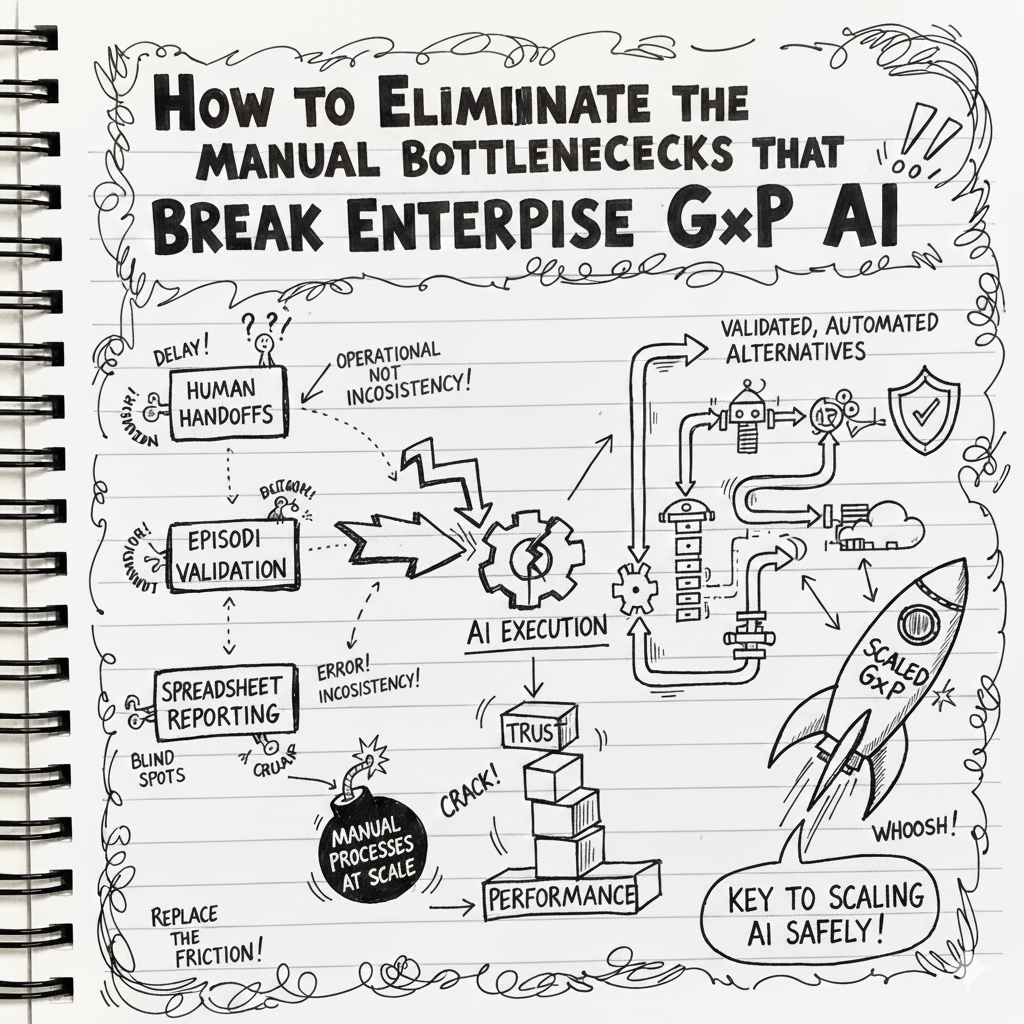
Consolidate before you automate — The FDA consolidated 40 systems before building anything new. Automating fragmented, siloed data architectures produces faster wrong answers. The foundation for continuous intelligence is unified, clean, GxP-compliant data infrastructure.
Make AI part of the workflow, not a parallel workstream — Elsa succeeded because it was embedded into daily tasks that FDA employees already performed reading, writing, summarizing rather than requiring them to adopt a new workflow in addition to their existing one. AI tools for pharma manufacturing must meet operators and quality professionals where they work, not require them to learn a foreign system.
Measure adoption, not just deployment — The FDA tracked AI adoption as a KPI: 1%, then 80%+. Most pharma companies can report how many AI licenses they have purchased; very few can report what percentage of their workforce uses AI tools daily. Without an adoption metric, transformation has no accountability.
10.0 The Broader Signal: What FDA Is Saying Without Saying It
A Regulator That Has Outrun Its Industry
The FDA's April 2026 announcement reveals a profound organizational irony. Despite budget freezes, workforce cuts, and public scrutiny, this government agency has advanced technology faster than the private companies it regulates. When the regulator outpaces and adapts more quickly than the industry it oversees, the traditional innovator-overseer relationship fundamentally shifts.
The FDA is not merely piloting technology. It is establishing a new baseline expectation for what data-driven collaboration between industry and regulator looks like. Companies that enter the RTCT program will be required to transmit structured, real-time safety and efficacy signals through validated cloud infrastructure. This is the opening specification of a regulatory environment that will, over time, reward organizations with mature data and AI capabilities and progressively disadvantage those operating on legacy architectures.
The Life Sciences Industry Must Close Its Own Gap
McKinsey estimates AI could unlock $60–110 billion in annual value for the pharmaceutical industry. This value remains trapped in inefficient, paper-based, retrospective processes, the same processes the FDA has targeted in its operations. Organizations that will capture this value won't wait for regulatory mandates; they will see the FDA's announcement as a starting gun, not a policy update.
For pharmaceutical manufacturers, especially small to mid-size companies and CDMOs that form the industry's production backbone, the urgency is greater. These organizations often lack the infrastructure, governance, and AI workforce to respond quickly when regulations shift. Building continuous intelligence capabilities now, while the pilot program is early and collaborative frameworks are forming, costs far less than retrofitting compliance after mandates solidify.
11.0 Conclusion: The FDA Has Reimagined, Now What Will Industry Do?
The FDA's real-time clinical trial pilot is more than a technology program. It is an organizational declaration: that six decades of operating inertia can be overcome in months when leadership is aligned, tools are purpose-built, and adoption is treated as a mission-critical metric rather than an optional enhancement.
When FDA AI Chief Jeremy Walsh said, "We are reimagining what information we need and when we need it to make a decision," he posed the foundational question every pharmaceutical manufacturer must now ask about its operations: What information do you need? When do you need it? What is the cost in efficiency, compliance, competitive positioning, and patient outcomes of not having it?
The industry long assumed the regulator sets the pace. That assumption no longer holds. The FDA has surpassed the industry it oversees on AI adoption, data modernization, and workflow reimagination, metrics that will define competitiveness in life sciences for the next decade. The question for every pharma manufacturing leader is not whether transformation is coming, but whether they choose to lead it or be compelled by it.
The 80% statistic is not a benchmark to admire. It is a challenge to match.